When people think about ERP implementations, they usually associate complexity with large enterprise systems used in manufacturing, banking, retail, supply chain, or global operations.
Platforms like SAP, Oracle, Microsoft Dynamics, and Salesforce have long been considered the gold standard of enterprise implementation complexity.
However, after spending years closely working with educational institutions and digital transformation initiatives, I have come to believe that Education ERP Implementation is one of the most challenging implementation domains of all.
And strangely, this complexity is still underestimated.
The Biggest Misconception About Education ERP
Many people assume Education ERP is limited to:
- Student records
- Attendance
- Fee collection
- Examination results
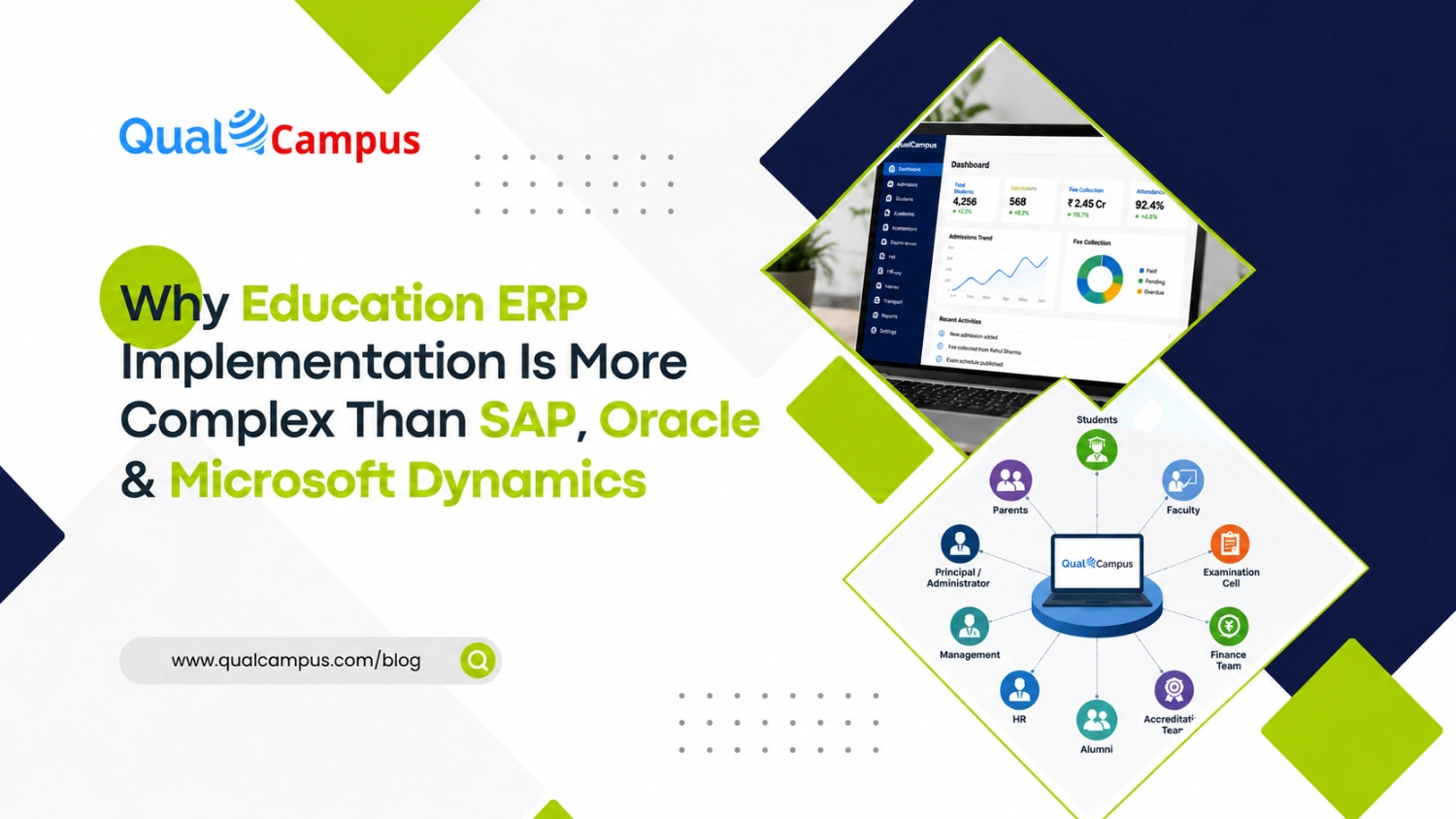
In reality, a modern educational institution functions like a highly interconnected ecosystem with academic, administrative, financial, operational, compliance, and communication layers all working simultaneously.
A university or large school group often manages:
- Admissions
- Academics
- Examination Management
- Timetables
- Fee Structures
- Scholarships
- Hostel Operations
- Transportation
- HR & Payroll
- Learning Management Systems
- Accreditation Processes
- Parent Communication
- Compliance Reporting
- Outcome-Based Education
- Research & Projects
- Alumni Management
Each department has its own workflows, dependencies, approvals, and reporting requirements.
Now multiply that across thousands of students, hundreds of faculty members, multiple campuses, regulatory frameworks, and continuously evolving academic policies.
That is where the real complexity begins.
Unlike Traditional ERP, Every Institution Is Different
One of the biggest differences between Education ERP and traditional ERP systems is standardization.
In industries like manufacturing or finance, processes are relatively mature and standardized globally.
But educational institutions are deeply customized environments.
Every institution has:
- Different academic structures
- Different grading systems
- Different fee policies
- Different examination rules
- Different attendance logic
- Different approval hierarchies
- Different compliance requirements
Even institutions affiliated with the same university often operate differently internally.
A statement frequently heard during implementations is:
“Our process is slightly different.”
In ERP implementation language, “slightly different” often means weeks of workflow analysis, configuration changes, exception handling, report modifications, and stakeholder discussions. Humans have an extraordinary ability to use the word “small” for operational changes capable of collapsing entire timelines.
Why Educational Institutions Operate Differently Than Traditional Enterprises
One of the biggest differences between Education ERP and traditional ERP systems is standardization.
In industries like manufacturing or finance, processes are relatively mature and standardized globally.
But educational institutions are deeply customized environments.
Every institution has:
- Different academic structures
- Different grading systems
- Different fee policies
- Different examination rules
- Different attendance logic
- Different approval hierarchies
- Different compliance requirements
Even institutions affiliated with the same university often operate differently internally.
A statement frequently heard during implementations is:
“Our process is slightly different.”
In ERP implementation language, “slightly different” often means weeks of workflow analysis, configuration changes, exception handling, report modifications, and stakeholder discussions. Humans have an extraordinary ability to use the word “small” for operational changes capable of collapsing entire timelines.
Education ERP Is Not Just Technology
A successful Education ERP implementation is not merely a software deployment project.
It is a combination of:
- Business Process Engineering
- Academic Workflow Design
- Change Management
- Stakeholder Coordination
- Training & Adoption
- Policy Interpretation
- Data Governance
- Institutional Transformation
Technical capability alone is not enough.
Implementation teams must understand how educational institutions function operationally, academically, and culturally.
For example:
A simple change in a student’s division can impact:
- Timetable allocation
- Faculty workload
- Attendance records
- Examination seating
- Internal assessment mapping
- Fee structures
- Transport routing
- Report generation
Everything is interconnected.
The Human Side Makes It Even More Challenging
Education is fundamentally people-centric.
Unlike corporate environments where efficiency is often the primary objective, educational institutions involve:
- Faculty preferences
- Parent expectations
- Student experience
- Management vision
- Accreditation pressures
- Legacy practices
- Academic autonomy
This means ERP implementation becomes as much about people management as technology management.
The implementation team must often act as:
- Consultants
- Trainers
- Coordinators
- Problem Solvers
- Process Architects
- Change Leaders
And occasionally, diplomats.
Book a demo of Cloud ERP for your Institute
The Future of Education ERP
The future of Education ERP is no longer limited to automation.
Institutions are now expecting:
- AI-driven insights
- Predictive analytics
- Smart academic planning
- Integrated learning ecosystems
- Outcome-based tracking
- Real-time dashboards
- Seamless stakeholder communication
- Data-driven decision making
This transformation requires ERP platforms that are not only robust, but also flexible enough to adapt to the evolving nature of education itself.
Over the years, it has been encouraging to witness institutions becoming increasingly open to digital transformation and process modernization. The journey is challenging, but the impact on institutional efficiency, transparency, and student experience is significant.
Education ERP is no longer a back-office system.
It is becoming the digital foundation of modern educational institutions.
Where can you find the Best ERP with CRM, LMS & SIS?
When it comes to finding ERP with CRM, SIS & LMS, you have several options available. While many CRM providers offer them, QualSoft stands out as one of the leading brands renowned for providing exceptional CRM, LMS & ERP solutions. Our comprehensive range of offerings includes features such as Customer Relationship Management with ChatBot, Fees Management, Admission Management, Exam Management, Learning Management, Student Training & Placement Management, Online Class Management System, and a Cloud Based Student Information Systems (SIS) top-notch.
If you’re considering implementing or upgrading your existing CRM system in your educational institution, whether it’s a University, College, School, or group of institutions, look no further than QualCampus. With our cutting-edge CRM, ERP & LMS solutions, you can streamline your administrative processes, enhance collaboration, and provide a seamless learning experience for your students. QualCampus is your ultimate one-stop solution for all your CRM, ERP & LMS needs in the education sector.