In today’s fast-evolving educational landscape, institutions are under constant pressure to deliver quality learning experiences while managing complex administrative tasks. From admissions and examinations to finance, attendance, HR, and student engagement, the sheer breadth of operations can overwhelm even the most seasoned administrators. The question is no longer whether technology should be adopted, but which technology approach ensures efficiency, transparency, and scalability.
Two models dominate this conversation: All-in-One ERP systems and Separate Standalone Applications. While standalone tools may seem convenient at first, the long-term benefits of an integrated Cloud ERP solution far outweigh them. Let’s explore why integration wins every time.
The Challenge of Separate Applications
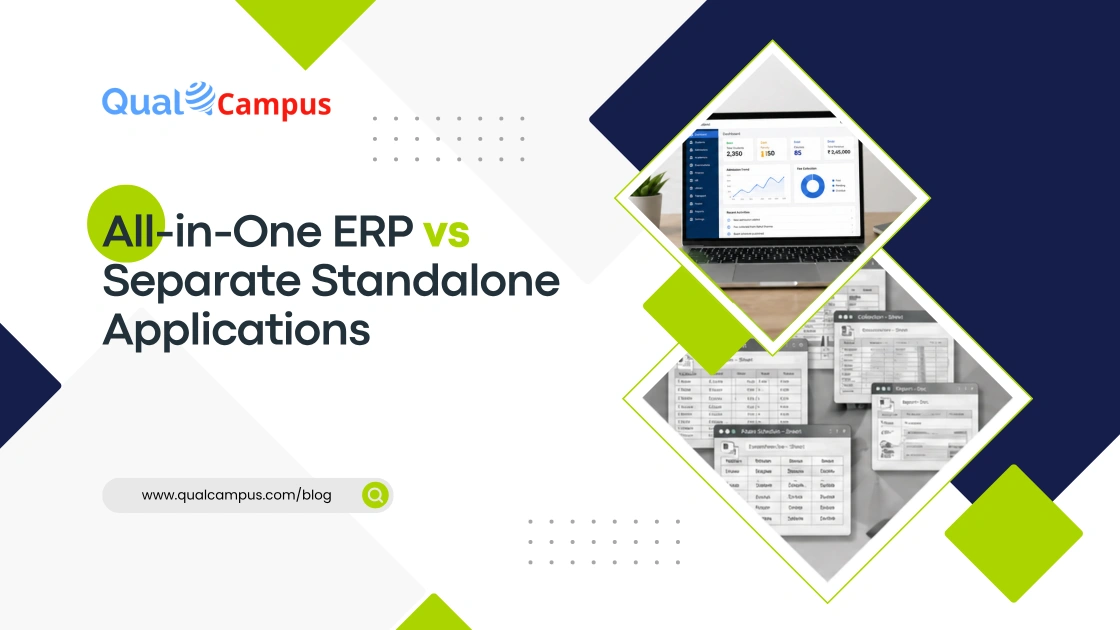
Many institutions begin with separate applications for different functions—an admissions portal here, a finance tool there, and perhaps a learning management system (LMS) running independently. While each tool may serve its purpose, this fragmented approach creates significant challenges:
- Isolated Data Sets: Information remains locked within individual systems, making it difficult to get a unified view of students, staff, or finances. As these isolated data sets do not communicate with each other, they make workflows inefficient and create mismanagement.
- Duplication of Effort: Staff often re-enter the same data across multiple platforms, wasting time and increasing the risk of errors.
- Limited Scalability: As institutions grow, managing multiple vendors, updates, and integrations becomes cumbersome.
- Poor Decision-Making: Without consolidated data, authorities struggle to make informed, timely decisions.
Why All-in-One Cloud ERP Wins
An All-in-One ERP system, deployed on the cloud, integrates every function of an institution into a single platform. Admissions, academics, finance, HR, library, hostel management, and even alumni relations can be managed seamlessly.
Here’s why integration is transformative:
1. Unified Data for Smarter Decisions
Cloud ERP provides a single source of truth. Authorities can access real-time dashboards showing student performance, fee collections, resource utilization, and more—all in one place. This holistic view empowers authorities to make data-driven decisions quickly.
2. Efficiency and Automation
Routine tasks such as fee reminders, attendance tracking, payroll processing, and exam scheduling can be automated. Staff spend less time on repetitive work and more on strategic initiatives that enhance student outcomes.
3. Scalability and Flexibility
Cloud ERP grows with the institution. Whether you’re managing a single school or a network of colleges, the system adapts to your scale without the need for multiple disjointed applications.
4. Cost-Effectiveness
Instead of paying for and maintaining several applications, institutions invest in one integrated solution. Cloud deployment further reduces infrastructure costs, as servers, maintenance, and updates are handled by the service provider.
5. Enhanced Collaboration
Faculty, administrators, students, and parents can access relevant information through secure portals & logins. This transparency builds trust and fosters collaboration across the institution.
6. Future-Ready Technology
Cloud ERP systems are continuously updated with the latest features, ensuring compliance with regulatory requirements and alignment with emerging educational trends such as online learning, digital assessments, and AI-driven analytics.
The Strategic Advantage for Educational Leaders
For authorities & leaders of educational institutions, the choice of technology is not just operational—it is strategic.
An All-in-One Cloud ERP system:
- Strengthens institutional reputation by showcasing professionalism and efficiency.
- Improves student satisfaction through seamless processes and timely communication.
- Enables compliance with government regulations and accreditation standards.
- Positions the institution as forward-thinking and technologically advanced.
Book a demo of Cloud ERP for your Institute
Conclusion:
While separate applications may appear manageable in the short term, they inevitably lead to inefficiencies and missed opportunities. An integrated Cloud ERP solution is not just a tool—it is a strategic partner in institutional growth. By unifying operations, enhancing transparency, and enabling smarter decisions, Cloud ERP ensures that educational institutions are equipped to thrive in the digital age.
Integration wins every time because it transforms complexity into clarity, effort into efficiency, and vision into reality.
Where can you find the Best ERP with CRM, LMS & SIS in the Market?
When it comes to finding ERP with CRM, SIS & LMS, you have several options available. While many CRM providers offer them, QualSoft stands out as one of the leading brands renowned for providing exceptional CRM, LMS & ERP solutions. Our comprehensive range of offerings includes features such as Customer Relationship Management with ChatBot, Fees Management, Admission Management, Exam Management, Learning Management, Student Training & Placement Management, Online Class Management System, and a Cloud Based Student Information Systems (SIS) top-notch.
If you’re considering implementing or upgrading your existing CRM system in your educational institution, whether it’s a University, College, School, or group of institutions, look no further than QualCampus. With our cutting-edge CRM, ERP & LMS solutions, you can streamline your administrative processes, enhance collaboration, and provide a seamless learning experience for your students. QualCampus is your ultimate one-stop solution for all your CRM, ERP & LMS needs in the education sector.